You dialed forty numbers this morning. Three people picked up. One hung up before you finished your name. If that’s your Tuesday, you already know cold calling isn’t broken because it’s rude it’s broken because the math barely works anymore.
Most industry trackers put cold-call appointment rates somewhere in the low single digits, and the person on the other end is more suspicious of unknown numbers than ever. So the real question isn’t whether cold calling still works for anyone. It’s how realtors can get more leads without cold calling, using systems that don’t depend on a stranger picking up at exactly the right moment.
This isn’t a pitch to swear off the phone forever. It’s a walk through seven systems built around people who already have a reason to talk to you before you show up.
What’s the Fastest Way to Get Real Estate Leads Without Cold Calling?
The fastest replacement is circle prospecting paired with a same-day text follow-up on any online inquiry both reach people who already have a reason to respond, unlike a random dial. Everything else on this list builds a pipeline that lasts longer but takes weeks, not days, to show results.
Speed and durability trade off against each other here. Circle prospecting and retargeting can produce a conversation within a week. Farming and data-driven targeting take longer to build but keep producing long after a single campaign ends.
Most agents end up running a fast system and a slow one at the same time, not picking just one.
Why Cold Calling Stopped Paying Off for Most Agents
Cold calling used to be the default because it was the fastest way to reach a stranger. That stopped being true. Caller ID, spam-labeling apps, and a decade of scam calls trained people to ignore numbers they don’t recognize, full stop.
Most industry estimates put cold-call appointment rates somewhere between 1% and 3%, depending on the list quality and the script. An agent dialing 100 strangers a day might land one or two real conversations that turn into anything at all.
Compare that to where leads are actually coming from now. In the National Association of Realtors’ 2025 Technology Survey, social media produced the highest number of quality leads for 39% of Realtors surveyed, ahead of their CRM at 23% and their local MLS at 17%. Cold calling didn’t crack the top of that list at all.
None of this means the phone is useless. It means dialing random strangers off a purchased list is a worse use of an hour than it used to be. That’s a different claim than “the phone is dead,” and mixing the two up leads agents to drop tactics that still work.

Is It Even Legal to Cold Call as a Realtor Right Now?
Yes, but with real limits. Federal rules require agents to scrub call lists against the National Do Not Call Registry, call only between 8 a.m. and 9 p.m. local time, and get prior written consent before using autodialers or prerecorded messages, and violations carry real statutory penalties.
That’s not a reason to panic. It’s a reason to treat compliance as a normal part of the job, the same way agents treat fair housing rules as normal, not optional.
Some states layer on their own mini versions of these rules, so a list that’s clean nationally can still cause problems locally. Checking the National Do Not Call Registry before a campaign takes minutes. Skipping it is how a routine outreach call turns into a real complaint.
This friction is one more reason agents look for alternatives that don’t hinge on a stranger’s phone number at all.
The Real Shift: From Interrupting Strangers to Reaching People Already Paying Attention
Every system below shares one trait: the person on the other end already has a reason to care before an agent shows up. That’s the actual shift here, not phone versus no phone.
A neighbor two doors down from a home that just sold cares about that sale. A homeowner who’s owned the same house for eleven years and built up serious equity is a different kind of prospect than a name pulled at random. Circle prospecting, farming, and data-driven targeting all point at people already primed to listen.
None of this is free or instant. It takes weeks to build momentum. But the ceiling is higher, because nobody has to fight a stranger’s instinct to hang up first.
For the fuller menu of lead sources beyond these seven — SEO, paid ads, referral systems, and more our broader guide to real estate lead generation covers that ground in depth. This piece stays narrow, on purpose: what actually replaces the phone.
System 1: Circle Prospecting Around Real, Local Activity
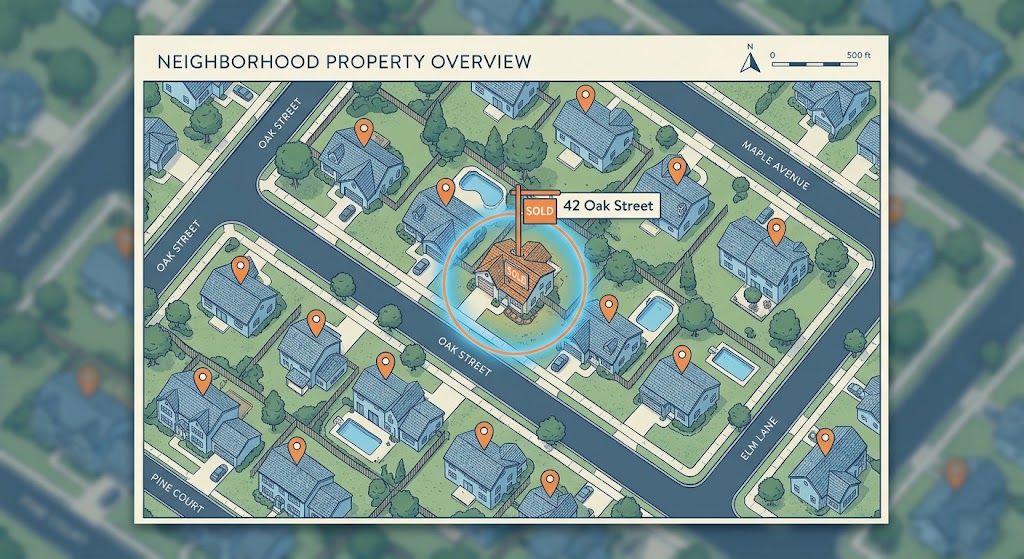
Circle prospecting means contacting homeowners in a tight radius around a home that just sold or just listed, usually 20 to 100 houses. The nearby sale gives an agent a real reason to reach out, not a script pulled from thin air.
Here’s the honest part: circle prospecting still often includes a phone call. A broker I worked with in Texas ran two straight years of pure cold dialing before switching to circle-based outreach tied to actual listings in his zip code. His answer rate more than doubled inside one season.
The difference wasn’t the phone. It was that people recognized the reason for the call the moment he opened his mouth.
Mix in a mailer and a follow-up text so the phone isn’t the only channel doing the work. A short script helps too: name the specific sale, ask what the neighborhood’s been like lately, and let the conversation go from there instead of pitching in the first ten seconds.
How Big Should Your Circle Be?
A tight circle of 30 to 50 homes usually outperforms a scattered 200, because everyone on the smaller list has a genuine stake in that nearby sale. Go wider only once a smaller radius is fully worked and following up.
System 2: Geographic Farming Built on Mail, Not Dials
Farming means picking one neighborhood and becoming the agent everyone there recognizes, month after month, whether they’re selling this year or five years from now.
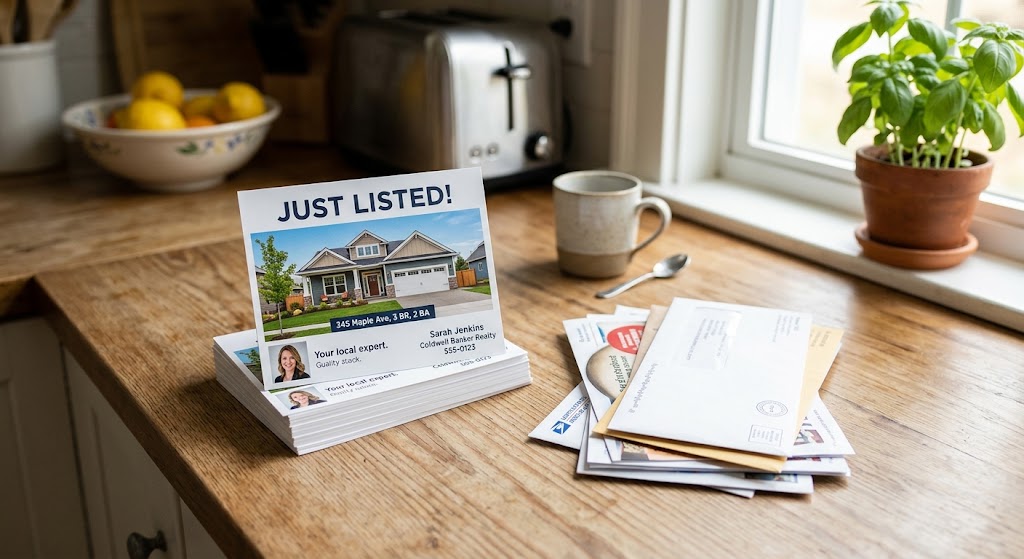
Direct mail is the backbone of most farming plans, and it holds up better than its reputation suggests. Industry benchmark data on real estate mailers generally puts response rates around 1% to 4% for ongoing farm campaigns, climbing higher for pieces tied to a specific just-sold or just-listed property nearby.
A postcard sent once does close to nothing. Agents who make farming work mail the same 300 to 800 homes every three to four weeks for a full year, minimum. That’s a slower answer than most agents want to hear, and it’s also just true.
One thing consistently outperforms a printed postcard: a short handwritten note after a closing, a new listing, or even a new neighbor moving in. It costs almost nothing and gets opened at a rate a bulk mailer never will, because it doesn’t look like a bulk mailer.
What Actually Goes on the Postcard
Skip the generic “thinking of buying or selling?” line — it competes with every other agent’s mailer in the same box. A specific local detail works better: a recent sale price on the same street, a note about a nearby school rating, or a plain market update for that exact block.
System 3: Data-Driven Targeting for Homeowners Likely to Sell
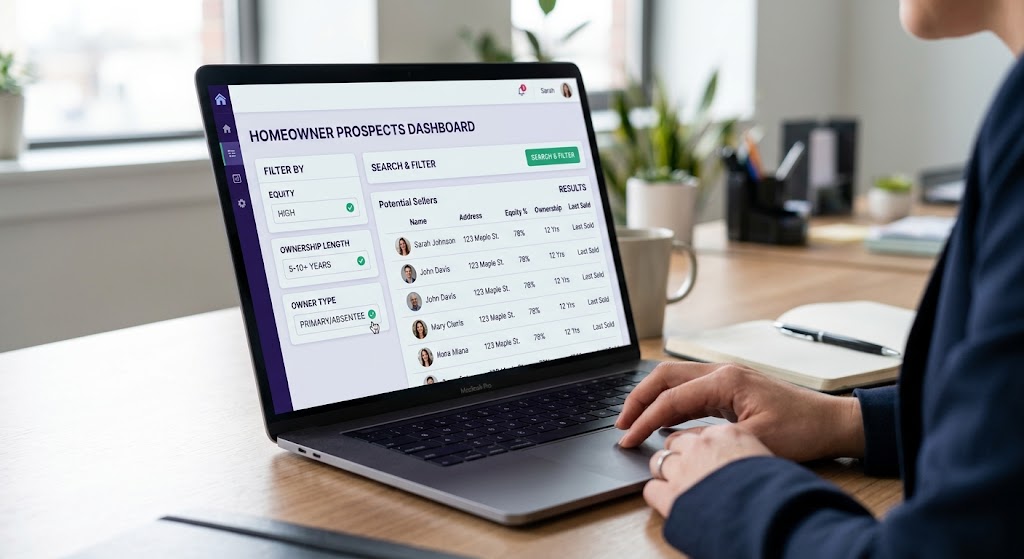
Not every homeowner is equally close to selling. Tools that pull public records — equity position, length of ownership, absentee owner status, pre-foreclosure filings — let an agent build a list of people statistically more likely to move soon, instead of guessing.
This is where a lot of “leads without cold calling” advice online quietly still assumes a phone call. It doesn’t have to. A data-driven list works just as well with mail, text, or a short visit as it does with a dial.
Here’s the part that depends on the agent, not the tool: data tells you who’s likely to sell, not who wants to hear from you today. Pair the list with a real reason to reach out — a market update, a nearby sale, a plain home-value estimate — instead of a generic pitch, and the response improves noticeably.
Where This Data Comes From
Most of it pulls from public county records: deed dates, assessed values, mortgage balances, and ownership length. Platforms built for real estate package this into filters an agent can search without pulling records by hand.
System 4: Neighborhood Pop-Bys and Light Door Knocking
A pop-by is a short, no-pressure visit: a small gift, a market flyer, or a magnet left at the door, sometimes with a quick hello if someone answers. It’s the in-person cousin of a postcard, not a pitch on a stranger’s porch.
This works because it’s memorable in a way a call or an ad rarely is. Someone forgets a phone call by dinner. They remember the neighbor who left a small local coffee gift card with their name spelled correctly on it.
Door knocking gets a bad reputation because most of it happens on the wrong list, with no plan for what comes after. Done on a small, targeted farm area and tied to a recent local sale, it behaves a lot more like circle prospecting than the door-to-door stereotype it’s stuck with.
Keep it simple: one useful item, a business card, and no ask for anything on the first visit. The ask comes later, once someone recognizes a name.
System 5: Retargeting the People Who Already Raised a Hand
Someone who visited a home-value page and left without filling out the form isn’t a cold stranger. They’re a warm lead who got distracted, and retargeting ads exist exactly for that gap.
A simple pixel on a website lets a small ad budget follow that visitor around for a week or two with a reminder to come back and finish. This costs a fraction of broad-audience social ads, because the only people seeing it already showed interest once.
Pair it with a text sent the same day someone fills out a form. A short, plain message like “Got your home value request, want me to walk you through it this week?” converts better than a delayed phone call almost every time, mostly because it arrives while the request is still fresh.
Setting Up the Basics
Most website builders and CRMs support a retargeting pixel with a short setup step, no developer required. The budget can start small; five to ten dollars a day is enough to stay in front of a modest local audience.

What These Systems Won’t Fix
None of this replaces follow-up. A circle-prospecting list, a farm area, and a retargeting pixel all still dump their best leads into whatever system tracks them next, or nowhere, if there isn’t one.
I’ve watched agents build a technically solid no-cold-call plan and still lose half their leads, because nobody was assigned to call back the person who filled out a form three days earlier. The channel changed. The follow-up problem didn’t. A CRM built around real estate follow-up is usually the missing piece, not another new lead source.
And at some point, most of these systems still end in a phone call, just a warm one, requested by someone who already wants to talk. That’s a different conversation than a cold dial to a stranger, but it’s still a phone in an agent’s hand. If picking up a phone under any circumstance is a hard no, that’s worth knowing before building a plan around “no calls, ever.”
Which System Fits Your Market and Your Week
Circle prospecting and light door knocking suit agents working one or two zip codes who don’t mind some face time. Farming with mail suits patient agents willing to fund a full year before judging results. Data-driven targeting and retargeting suit agents with some budget and a website already getting basic traffic.
Most agents end up running two of these at once, not all five. A crowded plan nobody keeps up with produces worse results than two systems run consistently, the same as it does with any other kind of marketing.
If the real issue isn’t how leads arrive but what happens once they do, the common mistakes agents make managing new leads is worth reading next.
Quick Answers Before You Pick a System
Do I have to stop making calls completely? No, and trying to isn’t the point. The goal is dropping cold dials to strangers, not every phone conversation. A callback to someone who asked for a home value estimate is a warm call, not a cold one, and warm calls still close deals.
How long before any of this produces a real lead? Circle prospecting and retargeting can produce a conversation within one to two weeks, since both reach people already primed to respond. Farming and data-driven targeting usually need three to six months of consistent activity before results stabilize, longer in a competitive zip code.
Can these run alongside paid leads instead of replacing them? Yes, and most agents who do well run both. These five systems build long-term local trust that a purchased lead never will. Paid or exclusive leads add volume in months when the pipeline runs thin. Neither one on its own is a full plan.
What if I’ve tried circle prospecting or farming before and it didn’t work? Check two things before writing off the tactic: whether the list was actually tight and local, and whether the campaign ran long enough to matter. A farm mailed for six weeks and abandoned, or a circle of 300 random addresses with no follow-up, isn’t a fair test of either system.
The Next Step: Building a System, Not a Habit You’ll Drop by March
Circle prospecting, farming, data-driven lists, pop-bys, and retargeting all share the same requirement: someone has to run them consistently, and someone has to catch every lead that comes back. Most agents can build two of the five well. Almost none can run all five and still show houses on the weekend.
That’s the specific gap Crenest’s exclusive lead and CRM setup is built to close: matching agents with real seller and buyer activity instead of a purchased list of strangers, then tracking every response so nothing goes cold from a missed follow-up. You can see what agents already running it have to say on the testimonials page.
Pick one system from this list that isn’t running yet. Give it a real quarter before judging it. Add the next one once the first runs without needing daily attention.