Your phone hasn’t rung in six days. You keep checking it anyway.
That’s not a personal failing. That’s what happens when lead generation runs on hope instead of a system. I’ve watched agents blame themselves for a slow month when the real problem was that their only lead source was “wait for a referral.”
Nine years of building marketing and follow-up systems for real estate agents taught me something most guides skip: generating a lead isn’t the hard part anymore. Most agents can get a name and a phone number. Turning that into a closed deal, six months from now, without burning out chasing every new platform, that’s the actual skill.
This piece walks through fifteen ways real agents fill their pipeline in 2026, what each one actually costs, and why some leads never become clients no matter how good the marketing was. Pick two or three that fit your budget and your week, not all fifteen at once.
What Is the Best Way to Generate Real Estate Leads in 2026?
The best way to generate real estate leads in 2026 isn’t one channel. It’s a mix: local SEO for search intent, an active referral system, one paid channel for faster volume, and a CRM that handles follow-up. Agents relying on a single source are one slow month from an empty pipeline.
If you’re picking a starting point, go with local SEO, your sphere of influence, and a CRM first. These three cost more time than money, and they build the kind of trust that paid ads alone can’t buy.
Once those are running, layer in paid channels to speed things up. The fifteen strategies below are ordered roughly that way: highest-intent and lowest-cost first, broader and more expensive further down.
15 Ways to Generate Real Estate Leads in 2026
Here are the fifteen ways I’ve watched actually move the needle for agents, ranked loosely from fastest-to-set-up to more involved.
1. Use Local SEO to Capture Homebuyers Searching on Google
Someone typing “homes for sale in” followed by their neighborhood or ZIP code has already made a decision. They’re not casually browsing. Local SEO puts your name in front of that person before you spend a single ad dollar.
It’s slow at the start. A page I wrote for a client sat on page two of Google for six months. Most agents give up right around that point. That’s exactly when it usually starts to move.
Once it works, though, it keeps working. A blog post from two years ago can still bring in a call this week, without you doing anything new to it.
Optimize Your Google Business Profile
This is the fastest local SEO win available, and most agents leave it half-finished. Fill in every field on your Google Business Profile. Add real photos, not stock images. Post something twice a month at least: a new listing, a closed sale, a market note.
Create Location-Specific Content
A generic “how to buy a house” post competes with thousands of national sites. It loses. A post about school ratings on one specific street, or why one subdivision sells faster than the one next to it, competes with almost nobody.
Build Local Authority and Reviews
Reviews aren’t just for the people reading them. Google reads them too, and factors them into how you rank. Ask for one right after closing, while the relief and gratitude are still fresh. Not three weeks later, when the request feels random.
2. Capture High-Intent Prospects With Google Ads
Local SEO takes months. Google Ads takes an afternoon to launch and can bring in a call by dinner.
Someone typing “sell my house fast” along with their city isn’t researching for fun. They’re close to acting, and a well-timed ad puts you in front of them at the exact moment they’re ready to talk to someone.
The ad isn’t the hard part. Where you send the click is. A homepage built for browsing loses most of that traffic. A landing page built around that one search, with one clear next step like “get your home’s value in 60 seconds,” keeps far more of it.
3. Generate Buyer and Seller Leads With Facebook and Instagram Ads
Google Ads catches people mid-search. Meta ads catch them before they’ve started searching at all, while they’re scrolling, based on what they already care about.
This works especially well for two things: showing up again for people who already visited your site, and reaching first-time buyers who are years from typing anything into Google but already saving photos of kitchens they like.
Video and simple lead-form ads tend to beat a static listing photo here. A form someone can fill out without leaving the app removes almost every reason to bail halfway through.
4. Build a Referral System Instead of Waiting for Referrals
Most agents treat referrals like weather: something that happens to them. That’s a mistake, because referred clients close at a noticeably higher rate and usually trust you before the first call.
Waiting for someone to think of you isn’t a system. Asking, on purpose, right after closing, while the experience is still fresh, is. Some agents build in a small thank-you gift or a referral bonus. Simpler still works too: a CRM reminder that just says “ask this client who they know.”
5. Turn Your Existing Network Into a Lead Source
Your sphere (old coworkers, neighbors, that one cousin who talks to everyone) is sitting on more business than most agents realize. It just doesn’t announce itself.
Treat it like a garden, not a one-time email blast. A short market update. A birthday text. A holiday card. None of it sells anything directly. It just keeps your name in the room when someone finally does say, “we’re thinking about moving.”
6. Use Open Houses to Build a Local Prospect Database
An open house that doesn’t sell the listing isn’t a failure. It’s still data: a buyer at a specific price point, in a specific area, with a rough timeline.
Most agents let that data walk out the door. A simple sign-in sheet or a QR code changes that. Six months of open houses, tracked properly, becomes a real local list, one you can keep marketing to long after any single house has sold.
7. Create Content That Answers Local Buyer and Seller Questions
Buying or selling a house is confusing for almost everyone doing it. Whoever answers the real question first usually earns the trust first.
A city-specific question like “is now a good time to sell?” beats generic advice every time, because it answers exactly what a local searcher typed, not a one-size-fits-all version of it. Write it once, and it can keep working for years. A single ad campaign stops the day you stop paying for it.
8. Use YouTube to Build Long-Term Visibility
YouTube sits somewhere between a search engine and a social platform, and video there tends to stick around far longer than a post anywhere else.
A neighborhood walkthrough. A plain, honest “what $500k buys you right now” comparison. These work because they give a viewer something a listing photo can’t: an actual sense of the street, the noise, the light.
Consistency beats production value here. A rough phone video posted every week will usually outperform one polished video posted twice a year.
9. Turn Instagram Into a Local Lead Funnel
A pretty listing photo gets likes. It doesn’t get a message.
Agents generating real leads on Instagram use Stories with a poll or a question, Reels that walk through a property or a market shift, and a bio link that goes somewhere specific, like a valuation tool or a buyer’s guide, instead of a generic homepage. The goal isn’t the like count. It’s moving someone from following you to messaging you.
10. Build Professional Referral Partnerships
Mortgage brokers, divorce attorneys, financial planners, contractors: they already talk to your future clients before you do.
This only works if it’s genuinely mutual. Send a mortgage broker good business without keeping score, and most will eventually send it back on their own. A handful of these relationships, built over a year or two, can become one of the steadiest lead sources an agent has. It’s often one of the cheapest, too.
11. Build Seller Leads Through FSBO and Expired Listings
Someone selling their own home, or watching a listing expire without an offer, has already decided they want out. Something just didn’t work.
Only 5% of U.S. home sales closed as For Sale By Owner over the past year, an all-time low, according to the National Association of Realtors’ 2025 Profile of Home Buyers and Sellers. That low number matters here. It means most FSBO sellers eventually list with an agent anyway. The question is only whether it’s you. This isn’t the moment for “ready to list with me yet?” It’s the moment for something more useful: why the listing might not have moved, or what’s shifted in the local market since it went up.
12. Use Paid Real Estate Lead Platforms Carefully
Paid lead platforms can genuinely help. Early in my career, I put a client’s whole month’s budget into shared leads before realizing four other agents in the same office had bought the exact same list. That mistake is why I now tell every client the difference between shared and exclusive real estate leads matters more than which platform they pick.
| Shared Leads | Exclusive Leads | |
| Sold to | Multiple agents at once | One agent only |
| Typical cost | Lower per lead | Higher per lead |
| Response speed | Often decides who wins the client | Less pressure to be first |
| Conversion rate | Lower, on average | Higher, on average |
Shared leads can still work if you’re fast and follow up within minutes. Exclusive leads cost more upfront but remove the race entirely. Which one fits depends on how much time you actually have to respond the second a lead comes in. For a longer breakdown, see our full shared vs. exclusive leads comparison.
13. Outsource Real Estate Lead Generation
Running ads, writing content, and managing landing pages on top of showings and negotiations is a lot for one person. At some point, something gets dropped, and it’s usually the marketing, because closing a client feels more urgent than finishing a blog post.
This is where working with a dedicated real estate lead generation service tends to make sense, not as a replacement for the relationship-based strategies above, but as a way to keep the digital side running while you handle the parts only you can do. It fits best when you already have budget but not the hours.
14. Use a CRM to Organize and Nurture Every Lead
Most agents don’t have a lead problem. They have a follow-up problem.
After years of watching this play out, the mistake I see most often isn’t a weak lead source. It’s a good lead, texted once, then forgotten in three weeks of showings and paperwork. A real estate CRM fixes that by putting every lead in one place and reminding you, automatically, who needs a call today.
The agents who use one consistently aren’t necessarily generating more leads than everyone else. They’re just losing fewer of the ones they already have.
15. Combine Multiple Channels Into One Lead Generation System
Picking one strategy from this list and expecting it to carry an entire business is the single biggest mistake I see agents make, more than picking the “wrong” one.
Local SEO brings in people already searching. Ads fill gaps fast when you need volume now. Your sphere and referral network bring in business that trusts you before you’ve said a word. Content and video build a reputation that outlasts any single campaign. A CRM ties all of it together so none of it goes to waste.
None of these need to run at full strength at once. Two or three, running consistently, beat all fifteen running halfway.
Which Real Estate Lead Generation Strategy Is Right for You?
The right strategy depends on your budget and time, not on what’s trending. New agents with more time than money should build their sphere, work open houses, and start local SEO. Agents with budget but little time move faster with paid ads or exclusive leads. Most agents need a mix of both.
Budget alone doesn’t decide it. Personality does too. Some agents will do open houses every weekend for a year and never burn out. Others would rather write a blog post at 6am than knock on a single door. Pick strategies you’ll actually keep doing, not the ones that sound most impressive on paper.
How Much Does Real Estate Lead Generation Cost in 2026?
Costs range from nearly free to several thousand dollars a month, depending on the channel. Sphere-building, referrals, and open houses cost time, not money. SEO and content need a smaller upfront investment that pays off slowly. Paid ads and lead platforms cost the most, but move the fastest.
There’s a catch with the fast channels: they stop producing the moment you stop paying for them. A slower, cheaper channel like SEO keeps working quietly in the background, even during a month you can’t spend a dollar on ads.
The number that actually matters isn’t cost per lead. It’s cost per closed deal. An agent paying more per lead but converting one in five is doing better than one paying less but converting one in twenty. For exact ranges by channel, see what real estate leads cost in 2026.
Why Real Estate Leads Don’t Always Become Clients
A lead isn’t a client. It’s someone who showed a flicker of interest: filled out a form, clicked an ad, asked one question at an open house. That’s it. Nothing more is guaranteed.
Myth: More leads always means more closings. Fact: A pile of unqualified leads with no follow-up closes worse than a smaller list that gets called back consistently. Volume without a system just means more names to lose track of.
Agents who convert better usually qualify before they pitch. They ask about timeline and motivation before pushing for a showing. And they accept something a lot of guides skip past: most leads aren’t ready the day they show up. Patient, repeated follow-up turns interest into a client far more often than one aggressive call ever does. Crenest’s piece on common mistakes agents make managing new leads covers the follow-up side of this in more depth.
What a Real Estate Lead Generation Funnel Looks Like
Every strategy on this list feeds into the same basic path, even though they start in different places.
It begins with awareness: someone sees your ad, reads a post, hears your name from a friend. That turns into interest: a follow on Instagram, a newsletter signup, a few minutes browsing your listings. From there, real consideration starts: a home valuation request, a direct message, someone walking into an open house.
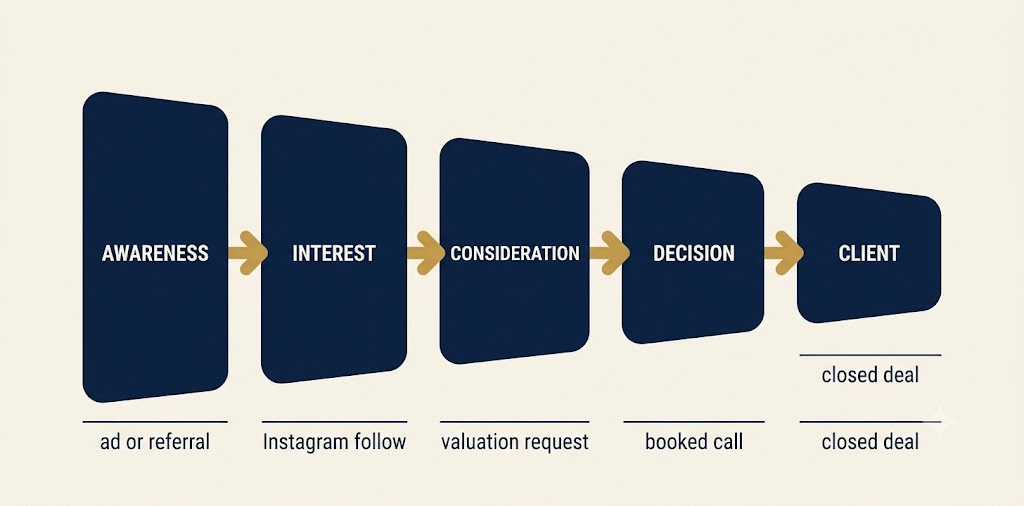
Consideration turns into a decision when someone books a call or asks you to represent them. And with the right follow-up, a decision turns into a closed deal, and if you’ve done this part well, a future referral too.
This is why one tactic alone rarely works. An ad might create the awareness. It’s the follow-up, the content, and the CRM that carry someone the rest of the way.
Want to Build a More Consistent Real Estate Lead Pipeline?
A pipeline gets steady when the strategies above stop running as separate experiments and start running as one connected system. That’s the specific gap Crenest is built to close: local SEO, exclusive leads, and CRM follow-up, working together instead of living in five different tools.
If you’re already running a few of these strategies but feel like you’re managing five tools that don’t talk to each other, that disconnect is usually where leads quietly fall through. Crenest brings local SEO, exclusive lead access, and CRM follow-up into one place, built specifically around how real estate agents actually work day to day, not a generic small-business marketing platform with a real estate label stuck on it. You can read what agents already working with Crenest have to say on the testimonials page.
Frequently Asked Questions About Real Estate Lead Generation
What is the fastest way to generate real estate leads?
Paid search ads, specifically Google Ads aimed at high-intent keywords, tend to produce leads the fastest, sometimes within days. The trade-off is cost: unlike SEO or referrals, the leads stop coming the moment you stop paying for the ads.
How can Realtors generate leads without spending money?
Your sphere of influence, a real referral system, open houses, and organic social media all cost time instead of money. Local SEO belongs here too, though it usually takes several months before it produces meaningful traffic and inquiries.
How much does a real estate lead cost?
Cost varies widely by channel and market, from essentially free with referrals and sphere-building, to real money for competitive paid ad keywords or exclusive lead platforms. What matters more than the sticker price is your cost per closed deal, not per lead.
Are exclusive real estate leads better than shared leads?
Usually, yes. Exclusive leads go to only one agent, removing the response-time race that comes with shared leads sold to several agents at once. They cost more upfront, but the higher conversion rate often makes them the better value overall.
How do I generate seller leads?
Seller leads tend to come from local SEO content, neighborhood farming, following up on FSBO and expired listings, and staying visible through your sphere and referral network. Direct mail and local involvement help too, since sellers often choose an agent based on reputation.
How do I generate buyer leads?
Buyer leads respond well to Google and social ads, active listing content, open houses, and content that answers real first-time-buyer questions. Since buyers often start looking long before they’re ready to act, consistent CRM follow-up matters as much as the first contact.
Is SEO worth it for real estate agents?
Yes, especially for agents planning to stay in one market for years. It takes longer to show results than paid ads, but the leads it produces tend to be higher-intent and effectively free once your content and rankings are established.
How long does it take to generate leads through SEO?
Most agents see real movement within three to six months, with stronger results building over six to twelve months of consistent posting. The exact timeline depends on local competition and how established your website already is.
What is the best CRM for real estate leads?
There’s no single best CRM. The right one depends on your budget, team size, and how much automation you want. What matters most is picking one you’ll actually use daily; a simple CRM used consistently beats a powerful one left untouched.
Final Thoughts
None of the fifteen strategies above is secretly the best one. The best one is whichever two or three you’ll actually run every week for the next year, without needing to feel motivated first.
Real estate lead generation in 2026 keeps splitting further between agents running an actual system and agents running on hope. That gap is only going to get wider as more of the early-stage searching moves online before a buyer ever picks up the phone.
Pick one strategy from this list you’re not doing yet. Start it this week. Add the next one once the first one is running on its own.